S6 · “No Official Culture”: Multiculturalism
- When did Pier 21 open and close?
- Who were the war brides?
- Why was Pier 21 called a gateway?
Answer key
- It opened on 8 March 1928 and closed in 1971.
- Mostly young British women who had married Canadian soldiers during the Second World War.
- Nearly one million newcomers entered Canada through it.
- understand how Canada changed its rules in 1967 and 1971
- analyse a political speech
- debate the meaning of multiculturalism
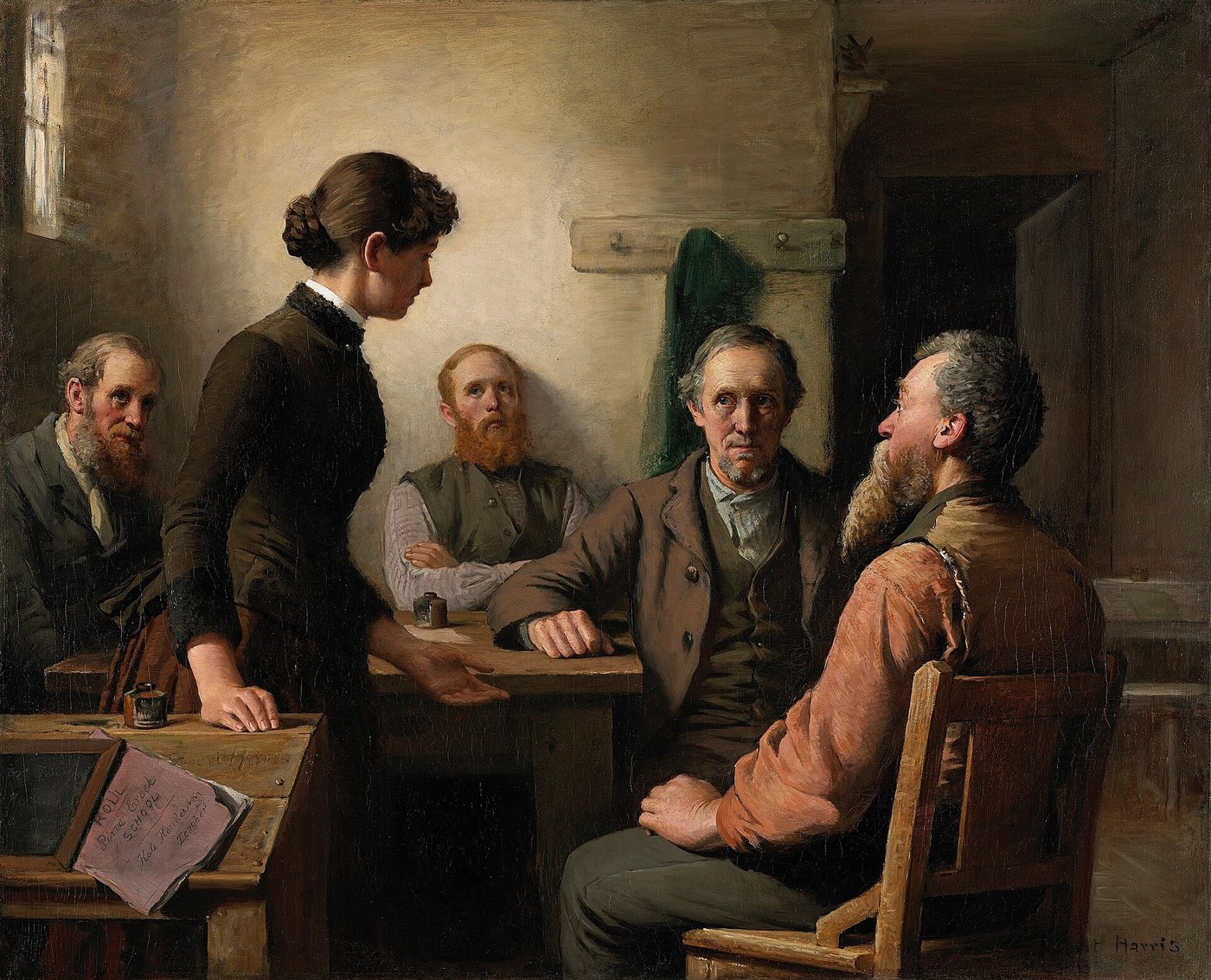
Look at the painting
Describe, then interpretCore
- Who is standing, and who is sitting?
- How do the men react to the young woman?
- What is the debate about, in your opinion? Read the caption.
Answer key
- A young woman teacher stands; four older men, the school trustees, sit.
- They look doubtful, amused or indifferent: they resist her.
- How the school should be run: who decides what the community teaches its children.
Why this painting? A community has to decide together how it lives and what it passes on to its children. Who sits at the table, and whose voice is heard? This is the question of the session.
Until the 1960s, Canada’s rules preferred immigrants from Britain, the United States and Europe. In 1967, Canada introduced a points system: applicants received points for education, language, work skills and age, not for their race or their country of origin. Immigration from Asia, the Caribbean, Africa and Latin America increased.
He announced four kinds of support: help for cultural groups, help to overcome barriers to full participation, “creative encounters and interchange among all Canadian cultural groups”, and help for immigrants to learn English or French. In 1982, the Canadian Charter of Rights and Freedoms (section 27) asked for the “preservation and enhancement of the multicultural heritage of Canadians”, and in 1988 Parliament passed the Canadian Multiculturalism Act.
UnderstandCore
- What changed in 1967?
- How many official languages does Canada have, and how many official cultures?
- Which word in the speech shows the idea of exchange between groups?
- What must immigrants learn, according to the policy?
Answer key
- The points system: newcomers were chosen for their skills, not for their origin.
- Two official languages (English and French) and no official culture.
- “interchange”, in “creative encounters and interchange”.
- At least one of the two official languages, English or French.
DebateStretch
Prepare arguments for and against this statement: “A country needs one shared culture.” Use the speech, Documents 1 and 2, and what you know from S1 to S5. Use on the one hand… on the other hand, admittedly, nevertheless, it could be argued that.
It could be argued that a shared culture…
Admittedly, Canada shares two languages; nevertheless…
Trudeau claims that…, which implies…
Answer key
For: shared values and languages help people understand each other; Trudeau himself asks newcomers to learn English or French. Against: Canada’s history shows that choosing one “quality” of newcomer led to exclusion (S3, S4); “no official culture” lets every citizen be fully Canadian without giving up their heritage, as Raphael kept his candelabrum.
Expanding your vocabulary
| Word | Meaning | Example |
|---|---|---|
| multiculturalism | a policy that recognises and supports many cultures in one country | Canada adopted multiculturalism in 1971. |
| bilingual | using two languages | Canada is officially bilingual. |
| to take precedence over | to be more important than | No group takes precedence over another. |
| a points system | a way of choosing immigrants by giving points for skills | The points system began in 1967. |
| to integrate | to become part of a society | Learning a language helps newcomers integrate. |
| heritage | traditions passed down from the past | the multicultural heritage of Canadians |
Petit glossaire en français
multiculturalism : multiculturalisme · take precedence : primer sur · points system : système à points · integrate : s’intégrer · heritage : patrimoine
In French, summarise Trudeau’s statement in four sentences for a French newspaper, and explain the difference between “multiculturalism” and the French idea of integration.
- Learn the vocabulary.
- Write your argument for the debate (120 to 150 words).
- Find out what “interculturalism” means in Quebec, in two sentences.