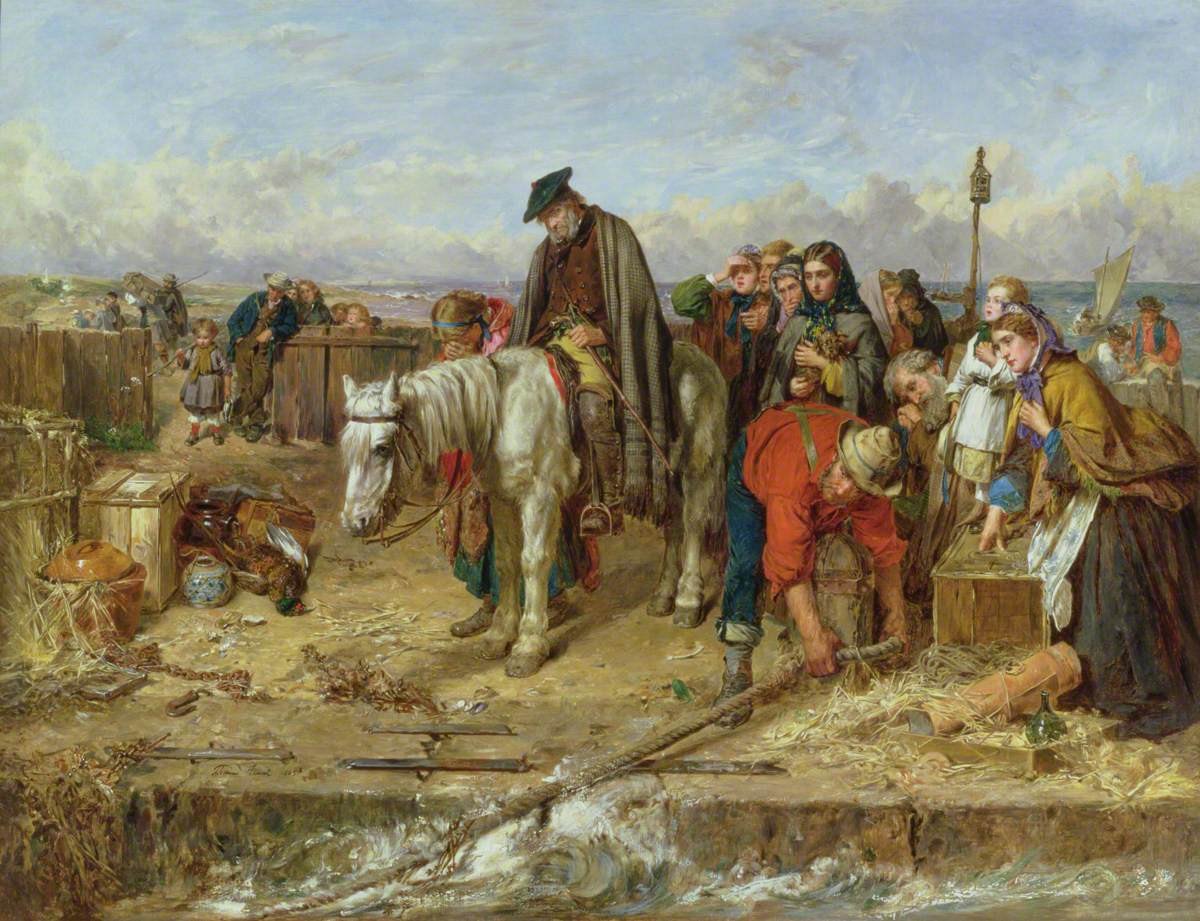
S1 · Why Leave? The Last of the Clan
- What is the difference between an emigrant and an immigrant?
- Name one English-speaking country that many people have moved to.
- Give one reason why people leave their country.
Answer key
- An emigrant leaves a country; an immigrant arrives in a new country. The same person is both.
- For example Canada, the United States, Australia, New Zealand or the United Kingdom.
- For example work, poverty, war, persecution, family, studies or the loss of land.
- describe a painting and say what it suggests
- sort the reasons for migration into push and pull factors
- use the language of cause and consequence
Look at the painting
Describe, then interpretCore
- Where are we? What has just happened? Look at the sea, the quay and the rope.
- Who is left on the quay? Look at their age.
- How do they feel? Find three clues.
- Why is the title The Last of the Clan?
In the foreground, I can see…
The old man seems to be…
This suggests that…
The title implies that…
Answer key
- A Highland quay in Scotland; a steamer has just left with emigrants, and the rope has just been thrown off.
- Mostly old people, women and children: the young and strong have gone.
- Faces turned to the sea, a woman crying, heads down, bags on the ground.
- Only an old man and his granddaughter are left of a once powerful clan: the clan has emigrated.
The Highland Clearances: in the 18th and 19th centuries, many landowners in the Scottish Highlands removed families from their land to make room for sheep. Many of these families emigrated, a great number of them to Canada, especially Nova Scotia (“New Scotland”).
Understand the documentCore
- Who is speaking?
- What do the speakers no longer own?
- Find the word that means “a rope used to tie a ship”.
- What is the tone of the text?
Answer key
- A member of the clan who stayed behind: “myself among the number”.
- “not a single blade of grass in the glen”: no land at all.
- hawser.
- Sad, nostalgic, bitter: a lament for a lost way of life.
Push and pull factorsCore
Sort these reasons into a table: push (what makes people leave) or pull (what attracts them).
Answer key
Push: loss of land, war, persecution, poverty. Pull: jobs, family already there, land to farm, safety, studies.
Cause and consequenceStretch
Join the ideas with because of, due to, as a result, which led to, so many… that.
- Landlords wanted sheep. Families lost their farms.
- Many Highlanders emigrated. Nova Scotia has a strong Scottish heritage.
- Canada has received newcomers for centuries. Almost one in four people is an immigrant.
Answer key
- Landlords wanted sheep, which led to families losing their farms.
- So many Highlanders emigrated that Nova Scotia has a strong Scottish heritage.
- As a result of centuries of immigration, almost one in four people in Canada is an immigrant.
Expanding your vocabulary
| Word | Meaning | Example |
|---|---|---|
| to emigrate / to immigrate | to leave a country / to settle in a new one | Many Highlanders emigrated to Canada. |
| a newcomer | a person who has recently arrived | Newcomers often learn English or French. |
| a host country | the country that receives newcomers | Canada was their host country. |
| push / pull factors | reasons to leave / reasons to come | Poverty is a push factor. |
| a lament | a song or text of sorrow | The painting is a lament for the clan. |
| to be left behind | to stay when others go | The old were left behind. |
Petit glossaire en français
emigrate : émigrer · newcomer : nouvel arrivant · host country : pays d’accueil · lament : complainte · left behind : laissé derrière
A French friend thinks that Canada is “a country of French and English people only”. Using Document 2, explain to them in English, in three sentences, why this is not true.
- Learn the vocabulary of the session.
- Write 80 to 100 words: “Why do people leave home?” Use two push factors and two pull factors.
- Find one person in your family or your town who came from another country or region, and note one thing they brought with them.