S5 · Pier 21: Gateway to Canada
- What was the Head Tax, and how much was it in 1903?
- What happened to the Komagata Maru?
- Which prime minister apologised in 2016?
Answer key
- A tax on every Chinese newcomer; $500 in 1903.
- It arrived in Vancouver in 1914 with 376 passengers; most were refused and the ship was forced to return to India.
- Justin Trudeau.
- discover a place of arrival and memory
- understand who came through Halifax and why
- tell a personal arrival story with past tenses
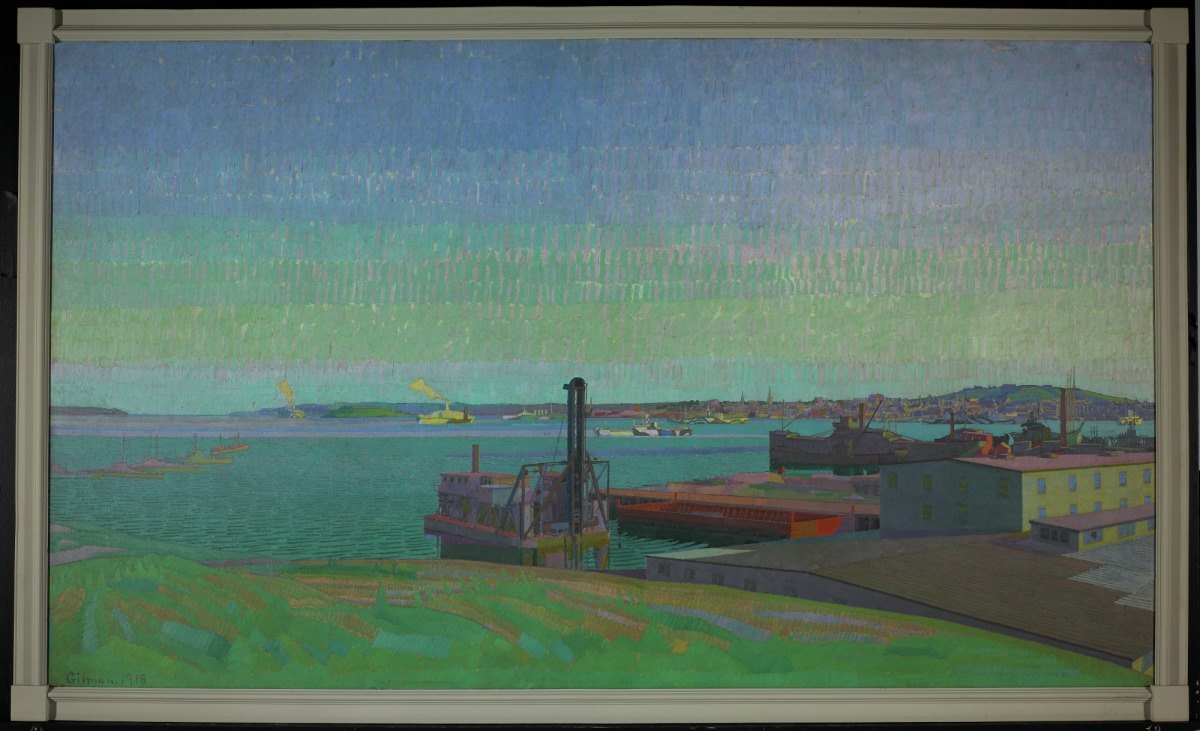
Look at the painting
Describe, then interpretCore
- What do you see in the foreground, in the middle and in the background?
- Look at the ship at the quay. Why is it painted with strange shapes?
- What mood does the painter create?
Answer key
- Green hills in the foreground, a ship, a quay and factories in the middle, the water and distant hills behind.
- It is “dazzle” camouflage, used in the First World War to confuse enemy submarines.
- Calm, glowing, almost peaceful, although the harbour had just been destroyed by an explosion.
In December 1917, a ship carrying explosives blew up in Halifax Harbour, killing nearly 2,000 people. In 1918, the Canadian War Memorials Fund asked the British painter Harold Gilman to paint the harbour in wartime. It was his largest painting, and one of his last: he died in 1919.
Pier 21, an immigration shed on the Halifax waterfront, opened on 8 March 1928 and closed in 1971. Nearly one million immigrants, refugees, war brides and evacuee children came through its halls before travelling across Canada by train. During the Second World War, about 500,000 Canadian soldiers left for Europe from Pier 21.
After the war, some 48,000 war brides, mostly young British women who had married Canadian soldiers, and 22,000 of their children came to Canada, most of them through Pier 21. Many “displaced persons” followed, among them survivors of the Holocaust. In 1951 alone, almost 94,000 people arrived there. Today, Pier 21 is the Canadian Museum of Immigration.
Sources: The Canadian Encyclopedia, “Pier 21”; Government of Canada, opening of the Canadian Museum of Immigration at Pier 21, 2011; Canadian Museum of Immigration at Pier 21.
UnderstandCore
- When did Pier 21 open and close?
- Name four groups who arrived there.
- Who were the war brides?
- Why did Pier 21 close? Make a hypothesis.
Answer key
- It opened on 8 March 1928 and closed in 1971.
- Immigrants, refugees, war brides and evacuee children (also displaced persons).
- Mostly young British women who had married Canadian servicemen during the war.
- Air travel replaced ships: by 1970, fewer than 1,200 immigrants arrived in Halifax.
Tell an arrival storyStretch
Imagine you are a war bride arriving at Pier 21 in 1946. Write a letter home (150 words). Use the past simple, the past perfect (I had never seen…) and used to (In England I used to…).
Answer key
Model opening: Dear Mum, We arrived in Halifax this morning after nine long days at sea. I had never seen such a huge harbour. An officer checked my papers in a big hall, and then a lady from the Red Cross gave the baby some milk. In England I used to…
Expanding your vocabulary
| Word | Meaning | Example |
|---|---|---|
| a pier | a structure built out into the water where ships stop | Ships arrived at Pier 21. |
| a war bride | a woman who married a foreign soldier during a war | 48,000 war brides came to Canada. |
| a displaced person | someone forced to leave their home by war | Displaced persons arrived after 1945. |
| to land | to arrive from the sea | They landed in Halifax. |
| a gateway | an entrance, a place of passage | Pier 21 was called the gateway to Canada. |
| a place of memory | a place where a society remembers its past | Pier 21 is now a place of memory. |
Petit glossaire en français
pier : quai, jetée · war bride : épouse de guerre · displaced person : personne déplacée · gateway : porte d’entrée · place of memory : lieu de mémoire
Visit the online story collection of the Canadian Museum of Immigration at Pier 21. Choose one story and present it in French to a partner in one minute: who, when, from where, first impressions.
Canadian Museum of Immigration at Pier 21Immigration history and stories
https://pier21.ca/research/immigration-history
- Learn the vocabulary.
- Finish the war bride’s letter (150 words).
- Read one story on the Pier 21 website and note three facts.